5 THINGS YOU’VE HEARD ABOUT DAIRY SUSTAINABILITY AND WHAT’S ACTUALLY TRUE
If you care about reducing your personal carbon footprint, here’s a question you might not expect: Do you enjoy dairy?
Many of us don’t have a front-row seat to farming. So, if you’ve ever wondered how sustainable dairy is, the best place to start is with the people who produce it. At Dairy Farmers of America (DFA), we’re a cooperative of 9,000 farmer-owners, so you could say we know a thing or two about dairy and sustainability — and these facts might surprise you.
Milk, yogurt, cheese, and other dairy favorites do more than taste delicious and give your body great nutrition — they’re good for the planet, too.
That might come as a surprise. When we think about living more sustainably, we usually picture lifestyle changes like switching to energy‑efficient light bulbs, using reusable bags and water bottles, buying from brands that share our values, or being more mindful about food waste at home. But something as simple as adding milk to your cereal or cheese to your favorite recipe can be part of that effort as well.
We all need to eat, why not eat sustainably? Luckily for us, dairy farmers already take sustainability seriously. They focus on caring for their cows, their land, and their communities, all while using sustainable farming practices that feed the world.
Are cow burps warming the planet?
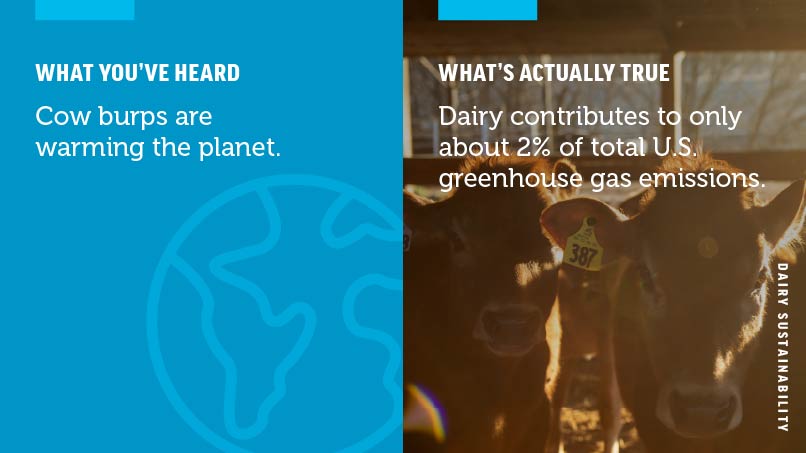
Just like driving gas-powered cars or using natural gas and electricity to heat and cool your home creates emissions, dairy farming does, too.
But its share is smaller than people realize. Cow burps, manure, and on-farm energy use all contribute, but it’s a relatively small part of the total.
In the United States, dairy accounts for about 2% of total greenhouse gas emissions. For comparison, the biggest contributors to greenhouse gas emissions are transportation (28%), electric power (25%), industry (23%), and residential and commercial (13%). Agriculture as a whole makes up 10%.
And just because dairy’s emissions are low, doesn’t mean they can’t be even lower.
Across the country, dairy farmers are reducing their carbon footprints — and hoofprints — because caring for their land and animals is part of the job.
Many dairy farms are using new technology and smarter management practices to cut emissions where they can. That can mean improving how manure is managed (by turning it into natural fertilizer for crops or even clean, dry animal bedding), switching to renewable energy like solar, recycling water, and upgrading barns and buildings with energy‑efficient fans, smart curtains, and LED lighting.
Dairy farmers are also balancing out their emissions by pulling carbon out of the environment through regenerative agriculture.
These crop-growing practices improve soil health and help farmland store carbon, rather than releasing it into the atmosphere. It’s another way farmers are thinking long term about their farms, their communities, and the planet they’ll pass on to the next generation.
The bottom line:
Dairy contributes to greenhouse gas emissions — like every food system does — but dairy’s share is modest compared to major energy and transportation sectors, and it has major nutritional payoff.
Are plant-based beverages more sustainable than dairy?
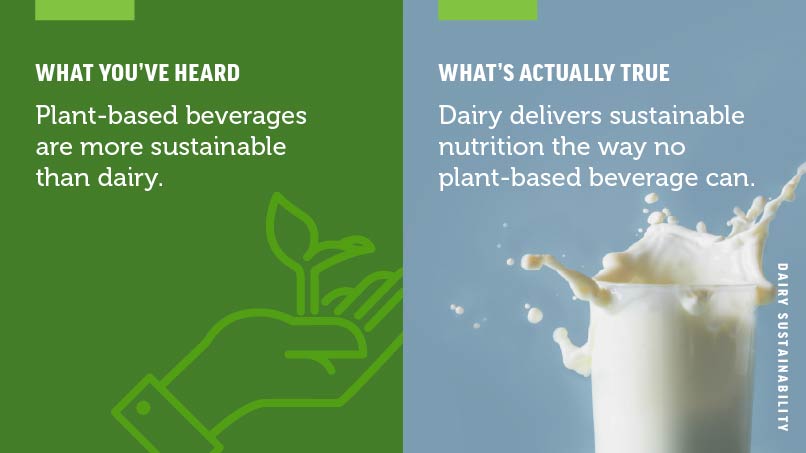
Marketing can be clever. Plant-based beverages like almond or oat drinks are often promoted as greener swaps for dairy.
At first glance, some plant-based options can appear to have a lower environmental footprint — but the truth is in the details. And what’s often missed in the conversation is nutrition.
No matter how eco-friendly the label or packaging looks, the ingredient list tells the true sustainability story.
Milk delivers more high-quality protein and essential nutrients per serving than most plant-based alternatives. (And it isn’t filled with stabilizers, oils, and gums.)
Dairy foods like milk, cheese, and yogurt are also more bioavailable, meaning they’re digested and absorbed as whole foods, not as isolated nutrients. The nutrients in dairy interact with one another in ways that enhance their overall impact, delivering nutritional benefits that go beyond what any single nutrient can provide.
Plant-based milks are fortified with vitamins and minerals that don’t have the same quality or bioavailability that dairy offers.
If you look strictly at emissions, land use, and water consumption, dairy has a bigger impact, but sustainability isn’t just about how something looks on a package — it’s about what you get out of it.
Researchers have found that even if dairy cows were removed from U.S. agriculture entirely, total greenhouse gas emissions would drop by only about 0.7% — while significantly reducing the availability of key nutrients people rely on every day. (And who would want to live in a world without cheese?)
Milk is affordable, easy to find, and packed with nutrition. So, when you compare what it actually takes to meet the same nutritional needs, people would need more plant-based alternatives to get the same benefits found in one serving of dairy — and producing, processing, packing, and transporting more product adds up to more emissions in the long haul.
The bottom line:
Plant‑based alternatives aren’t automatically more sustainable than dairy. Dairy plays a small role in emissions, but a big role in nutrition. Sustainable food is about more than carbon numbers alone. Dairy is packed with high-quality protein and essential nutrients while being affordable and accessible to many people.
Does dairy farming waste water?
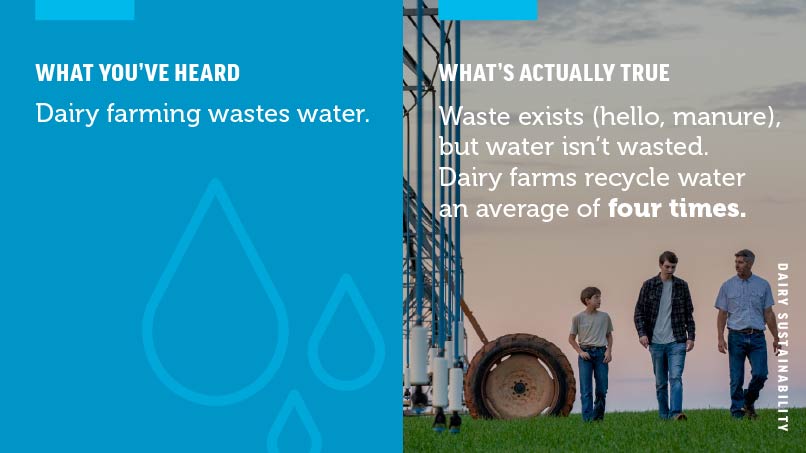
Dairy farms do have wastewater, but that doesn’t mean they waste water. Quite the opposite! Water gets recycled an average of four times on a dairy farm.
Water plays a big role on dairy farms — from keeping cows healthy and hydrated to safely cooling fresh milk and cleaning equipment. But most of that water doesn’t get used once and sent down the drain. Instead, it’s reused over and over in a carefully managed cycle. In fact, 47% of DFA farmer-owners have formalized water recycling practices.
For example, water used to quickly chill milk right after it’s collected can be reused to clean barns and equipment. From there, it can be captured again and applied to fields as irrigation, returning valuable nutrients (thanks to manure!) to the soil where feed crops are grown. Every step is designed to make the most of each drop while protecting local water quality.
Dairy farmers also work hard to manage wastewater responsibly. Storage systems and treatment lagoons help ensure that recycled water is used safely and at the right time, rather than running off into nearby waterways.
Just like with energy and emissions, water stewardship isn’t an afterthought on dairy farms. It’s part of day‑to‑day decision‑making — especially in regions where water is scarce and careful management matters even more.
The bottom line:
Efficient farming is sustainable farming, and dairy farmers are intentional about how they use and reuse water. Through recycling, treatment, and smart planning, dairy farmers conserve water while producing nutritious milk to feed us all.
Are dairy cows bad for the planet?
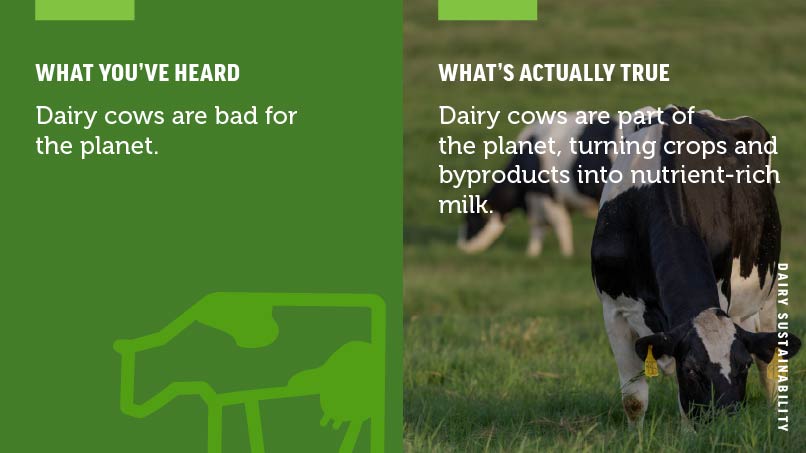
Unlike a Holstein, the issue isn’t black and white. In conversations about the environment, dairy cows often get singled out and blamed for climate change, land use, and resource consumption. In reality, dairy cows play an important role in feeding the world — and dairy farmers are constantly improving their environmental footprint.
Cows do something remarkable: They convert grasses and other plant materials into nutrient‑rich milk packed with high-quality protein and 13 essential nutrients to nourish people around the world. Many cows’ diets also include byproducts from food and crop production — such as almond hulls or citrus pulp — helping reduce food waste by giving those materials a productive second life.
Dairy cows are also closely connected to how land is managed. Farmers grow feed crops, rotate fields, plant cover crops, and protect soil health — practices that help reduce erosion, improve water retention, and store carbon in the soil. Healthy soil grows better crops, which feed healthy cows — and it all comes full circle.
That doesn’t mean dairy farming has zero environmental impact — no food system does. But dairy farmers are continuously improving how they care for their animals and their land, using new tools and technology to reduce their footprint while producing nourishing food.
Cows are part of the solution — not just the scapegoat.
The bottom line:
Dairy cows are part of our ecosystem, not bad for it! Dairy farmers responsibly and passionately run their farms, caring for animals, stewarding the land, and providing sustainably sourced, nutritious food — today and for future generations.
Do dairy farmers care about sustainability?
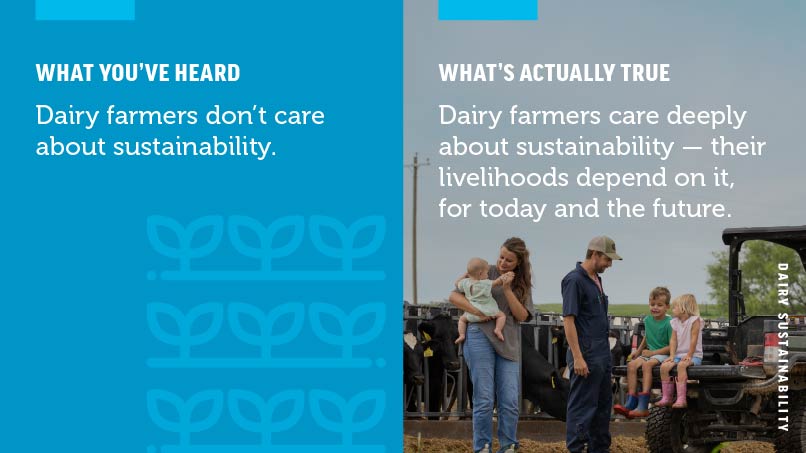
Sustainability isn’t a side project for dairy farmers. It’s built into how they care for their land, their animals, and their communities, and it has been for generations.
Most dairy farms are family‑owned and operated, and many dairy farmers are working land that has been in their families for decades. That long view shapes how they farm. Taking care of their soil, water, and animals isn’t about chasing trends — it’s about protecting the resources their farms depend on, today and in the future.
Across the country, DFA farmer-owners put that mindset into action. They recycle water, fight food waste, recycle manure, and adopt new technology to use energy more efficiently. They take part in farm assessments and industry programs that help measure their environmental impact and identify ways to keep improving.
Sustainability on dairy farms also means taking care of cows. Dairy farmers focus on cow comfort, nutrition, and health because healthy cows produce milk more efficiently — using fewer resources per gallon. Animal care and improved environmental outcomes go hand in hand.
But dairy farmers aren’t stopping there. They continue to test new ideas, learn from research, and adapt their practices as tools and technology advance. Caring for the environment is an ongoing process, not a finish line.
The bottom line:
Dairy farmers care deeply about sustainability. By stewarding their land, caring for their cows, and making thoughtful improvements on their farms, they’re working to produce nutritious food while protecting our planet's resources.
Dairy, done sustainably
However you enjoy dairy — in a glass of milk, a scoop of yogurt, or a favorite recipe — you can feel good knowing it comes from dairy farmers who take sustainability seriously every day.
Dairy is produced by real family farmers who are committed to caring for their cows, supporting their land, and finding better ways to reduce their environmental footprint — so nourishing people and protecting the planet go hand in hand.
Looking for sustainably sourced dairy products? Find a DFA farmer-owned brand near you and enjoy dairy that helps the planet.